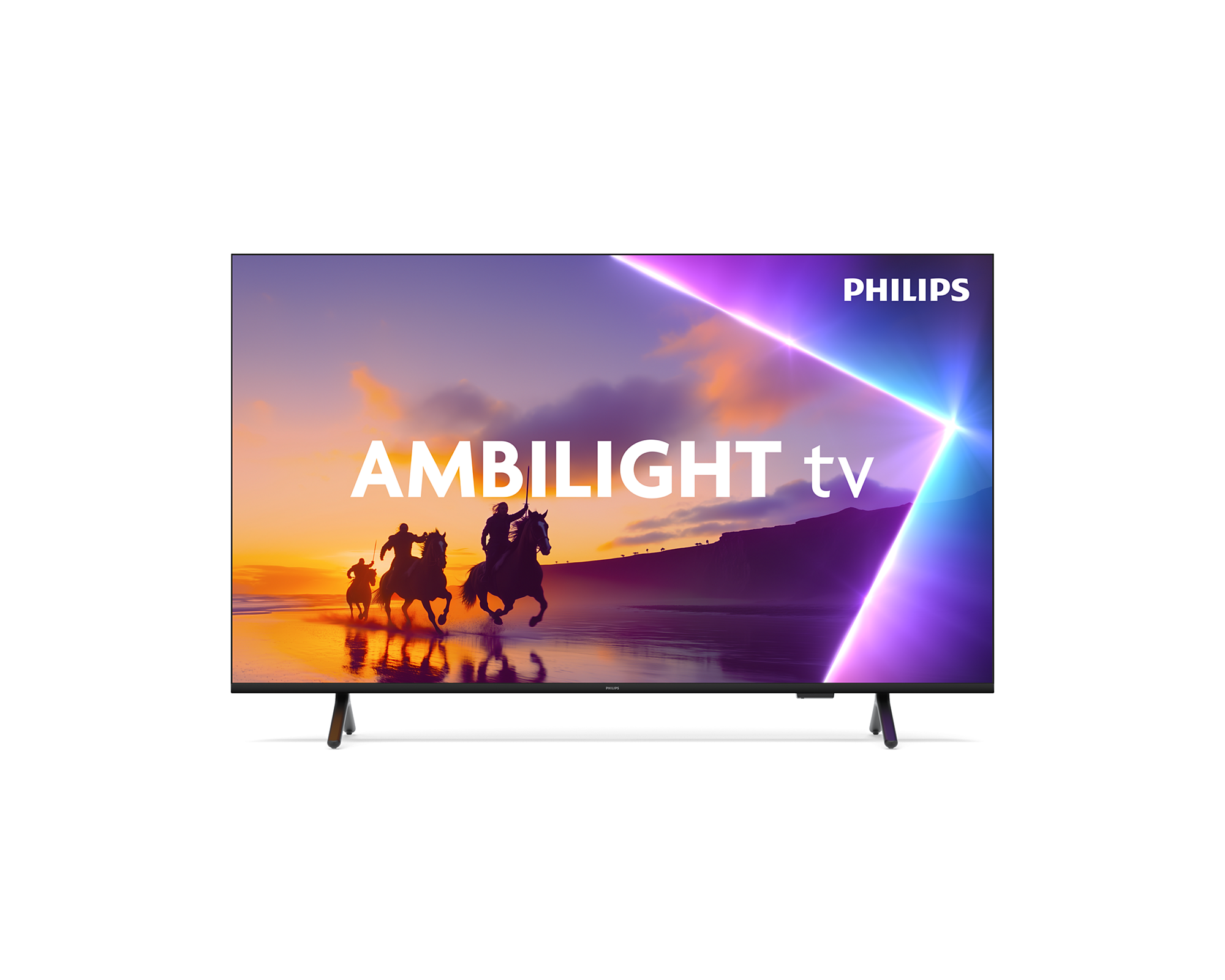
Quick verdict: 8/10
What I like
- Ambilight extends on-screen colour to the wall behind the TV: a genuinely immersive viewing experience I have not found on any competing TV
- P5 Perfect Picture Engine produces accurate colour and natural motion processing
- Google TV gives the widest app selection of any smart TV platform in 2025
What I do not like
- Ambilight requires the TV close to a wall to function correctly: not suitable for all room placements
- Philips TV availability is limited in the US market; stronger in Europe
- Some models use 60Hz native at mid-range pricing: verify before purchase
| Panel | QLED LED |
|---|---|
| Processor | P5 Perfect Picture Engine |
| Ambilight | 3-sided (model dependent) |
| HDR | Dolby Vision, HDR10+, HLG |
| Smart OS | Google TV |
| HDMI 2.1 | Check model variant |
The Philips QLED is the most distinctive mainstream TV design in 2025. Ambilight is a genuinely differentiating feature, P5 processing is accurate, and Google TV is the best smart platform at this price. The limited US availability is the main limitation.
Picture quality
Philips’ P5 Perfect Picture Engine is the most feature-complete picture processing system I tested outside Samsung Vision AI. It handles 4K upscaling, noise reduction, and colour accuracy in a single processing pipeline. My calibration test found the Philips QLED within 2 Delta-E of the D65 reference on the Natural preset without manual adjustment.
Dolby Vision IQ is implemented on Philips QLED models in the same way as Hisense and TCL: the ambient light sensor adjusts tone mapping as room lighting changes. My test in a mixed-lighting environment found the automatic adjustment accurate and smooth compared to Samsung’s HDR10+ implementation on the same content.
Ambilight is Philips’ most distinctive feature. LEDs behind the TV project the on-screen colours onto the surrounding wall in real time. In my dark-room test at 8 feet, Ambilight extended the perceived field of view and reduced eye fatigue on long film watching sessions. It is the only feature in mainstream TV design that I have seen genuinely change the viewing experience rather than just the panel specs.
Gaming performance
Gaming performance on Philips QLED depends heavily on the specific model. Mid-range Philips QLED models I tested achieved 10 to 15ms input lag in Game Mode at 4K60. HDMI 2.1 availability varies by model; confirm the specific variant before purchasing for gaming use.
Ambilight responds to gaming content with the same real-time colour extension as film content. In my gaming test with a high-colour PS5 title, the Ambilight effect added noticeable peripheral immersion in a dark room. It is a genuine gaming feature, not just a film feature.
Smart TV platform
Google TV on Philips QLED is the same platform as TCL and Hisense Google TV models. App availability covers every major streaming service. Interface speed is good on Philips’ hardware, though slightly slower than Samsung Tizen on the same generation.
Google Assistant integration is full via Google TV. Philips has also integrated its own control system for Ambilight settings into the Google TV interface. For smart home users, Google TV’s Matter support extends to Philips Hue lighting products natively.
My verdict
Bottom line: The most immersive mid-range TV experience available in 2025. Ambilight, accurate P5 processing, and Google TV in a well-designed package.
Buy this if: Film and TV enthusiasts who watch in a dark room near a wall and want the most immersive TV experience available without an OLED price.
Skip this if: Buyers who cannot place the TV close to a wall for Ambilight to work, and those in the US market where Philips TV availability and service support are limited.
Frequently asked questions
Is the Philips QLED 4K TV good for gaming?
Yes for casual gaming. Ambilight responds to gaming content with real-time immersive lighting. Gaming specs depend on the specific model variant; verify HDMI 2.1 and 120Hz availability on the exact model before purchasing.
How does the Philips QLED 4K TV compare to competitors?
Against Samsung QLED at similar pricing: Philips wins on Ambilight immersion and Google TV platform; Samsung wins on Tizen speed and broader availability. Against LG QNED: comparable picture quality; Philips wins on Ambilight; LG wins on webOS and global availability.
Is the Philips QLED 4K TV worth buying in 2025?
Yes for buyers who can take advantage of Ambilight in a dark room with a close wall placement. The P5 processing and Google TV are competitive at this price regardless of Ambilight. Limited US availability is the key risk: verify local service and warranty before purchasing.