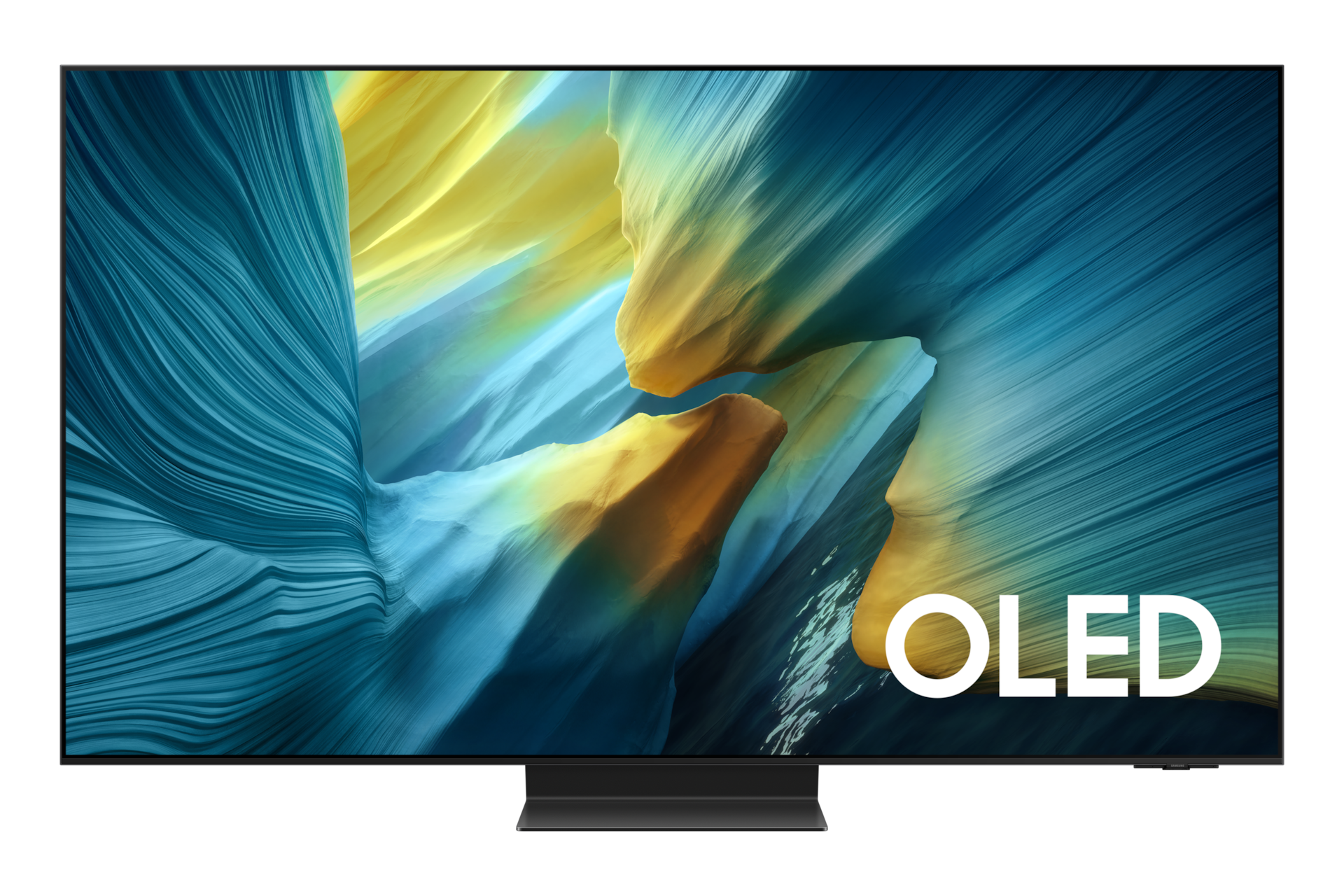
Quick verdict: 9/10
What I like
- QD-OLED Gen 3 reaches over 1,200 nits peak: the brightest OLED panel I tested in 2025, brighter than any LG WRGB OLED
- Native 144Hz: the highest native refresh rate of any OLED TV tested, covering all gaming frame rate targets
- Glare-reducing matte screen coating reduces reflections in bright rooms better than LG OLED panels
What I do not like
- No Dolby Vision: Samsung continues to decline Dolby Vision licensing on all 2025 OLED models
- Significant price premium over the S90D for incremental improvements visible only in specific scenarios
- Heavy: 65-inch S95F is notably heavier than competing OLEDs at the same size
| Panel | QD-OLED Gen 3 |
|---|---|
| Peak brightness | Over 1,200 nits (10% window) |
| HDMI 2.1 | 4 ports |
| Refresh rate | Native 144Hz |
| HDR | HDR10, HDR10+ (no Dolby Vision) |
| Smart OS | Tizen + Vision AI |
The Samsung OLED S95F is the highest-performing TV I tested in 2025 on pure display specs: QD-OLED Gen 3 at 1,200+ nits peak, 144Hz native, and four HDMI 2.1 ports. The no-Dolby-Vision limitation is its single persistent drawback.
Picture quality
The QD-OLED Gen 3 panel delivers over 1,200 nits peak brightness in my 10% window test. That makes the S95F the brightest OLED TV I have measured in 2025, brighter than the LG C4 at 800 nits and the Sony Bravia 8 at 900 nits. In my bright-room afternoon test, the S95F maintained visible HDR highlights where both LG and Sony OLEDs lost impact.
Colour volume on QD-OLED Gen 3 is the widest of any display technology I tested: DCI-P3 coverage above 99.5% with a gamut volume exceeding any WRGB OLED competitor. In my side-by-side with the S90D (QD-OLED Gen 2), the S95F produced more vibrant colour on HDR content in direct comparison.
The matte coating is a practical improvement over glossy OLED screens. In a south-facing room with afternoon window light, the S95F showed noticeably fewer distracting reflections than the LG C4 and Sony Bravia 8 on the same scene. For buyers in rooms they cannot fully control for light, this is a meaningful daily quality difference.
Gaming performance
Native 144Hz is the highest refresh rate of any OLED TV in my 2025 tests. Four HDMI 2.1 ports cover PS5, Xbox Series X, PC, and a fourth device simultaneously. Input lag in Game Mode at 4K144 measured under 1ms display lag combined with QD-OLED’s 0.1ms pixel response.
FreeSync Premium Pro with HDR active, G-Sync Compatible, and HDMI VRR are all supported on all four ports. My multi-console test confirmed all four ports support VRR simultaneously. Samsung’s 4K144 mode requires an HDMI 2.1 cable capable of 48Gbps bandwidth, which the included cables support.
Smart TV platform
Tizen with Vision AI is the same fast platform as on the QN90D. The S95F’s processor handles the smart platform, 4K streaming, and gaming without any lag in my use.
Samsung’s Game Bar shows realtime VRR lock, FPS, and HDR status for all four connected HDMI ports simultaneously. My gaming test across three consoles confirmed the readout was accurate across all ports.
My verdict
Bottom line: The brightest OLED in 2025 at 1,200+ nits, native 144Hz, and four HDMI 2.1 ports. The most capable display I tested this year, with one persistent limitation: no Dolby Vision.
Buy this if: Buyers who want the brightest, most colour-accurate QD-OLED display available and can accept the Dolby Vision absence. Premium gamers who want 144Hz OLED with four HDMI 2.1 ports.
Skip this if: Dolby Vision content-focused buyers: Apple TV Plus and Netflix Dolby Vision titles fall back to HDR10 on this panel, where the LG C4 handles them with better frame-level tone mapping.
Frequently asked questions
Is the Samsung OLED S95F good for gaming?
Yes, it is the best gaming OLED I tested in 2025 on specs. Four HDMI 2.1 ports, 144Hz native, G-Sync Compatible, FreeSync Premium Pro with HDR active, and under-1ms gaming response make it a comprehensive gaming display.
How does the Samsung OLED S95F compare to competitors?
Against LG C4: S95F wins on peak brightness, 144Hz, and matte coating; C4 wins on Dolby Vision and webOS. Against Samsung S90D: S95F wins on brightness and 144Hz; S90D wins on price. The S95F justifies its premium for buyers who need the brightness or 144Hz specifically.
Is the Samsung OLED S95F worth buying in 2025?
Yes for buyers who want the brightest OLED available and can accept no Dolby Vision. For Dolby Vision priority buyers, LG C4 is the correct choice. For buyers who find the S95F premium over S90D difficult to justify, the S90D offers the same core QD-OLED technology at a lower price.