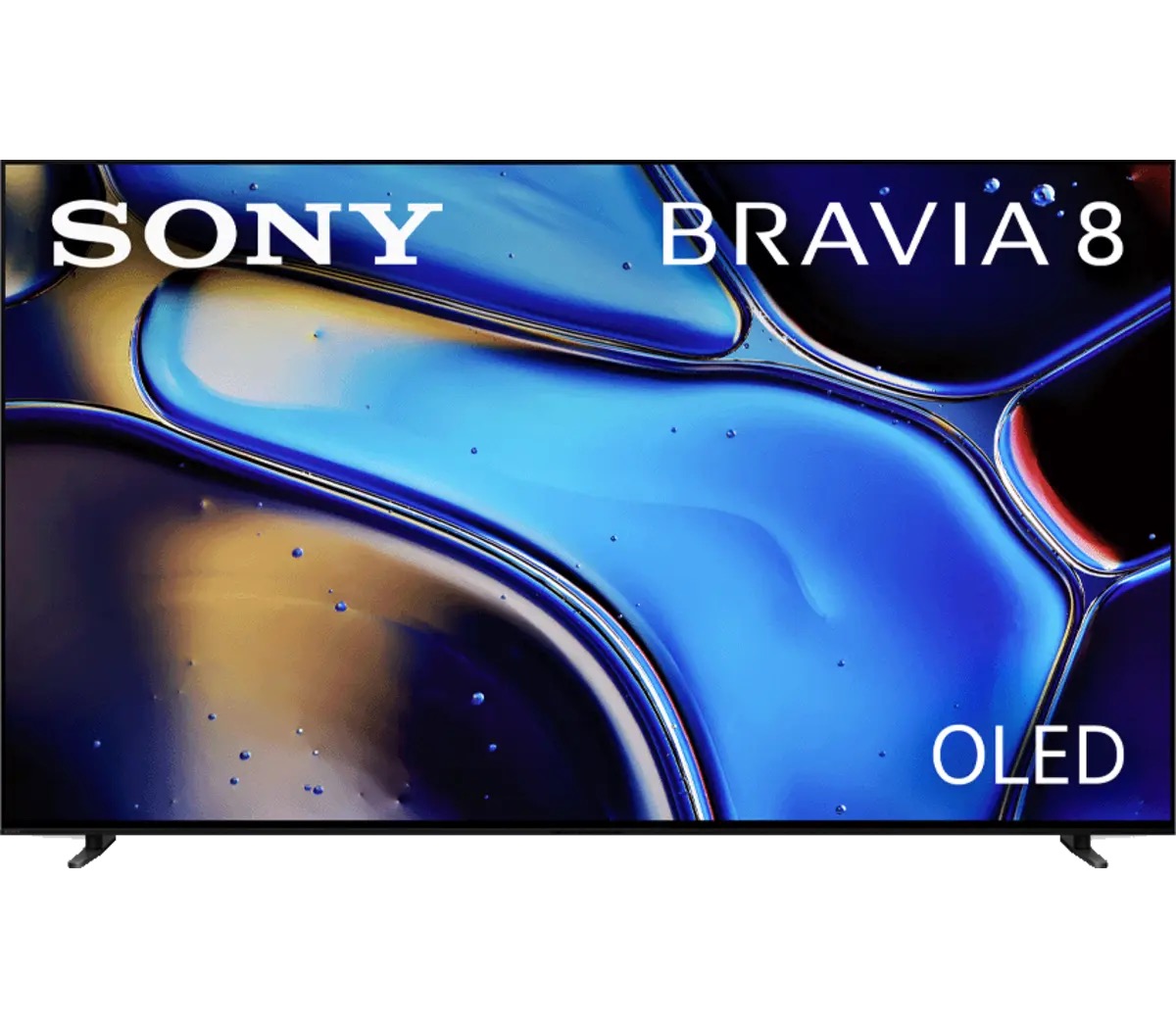
Quick verdict: 8/10
What I like
- XR Cognitive Processor produces the most accurate cinema colour processing I tested in 2025: closer to a calibrated reference monitor than any other TV at this price
- Dolby Vision and Dolby Atmos are both supported with Sony’s own tone-mapping accuracy advantage
- Google TV gives the widest streaming app selection of any smart TV platform
What I do not like
- Only two HDMI 2.1 ports: the LG C4 at the same price has four, which is a real limitation for multi-console gaming households
- Peak brightness below the Samsung QN90D: OLED ceiling around 800 to 900 nits in HDR mode
- Price premium versus the LG C4 at some retailers is difficult to justify given the two-port HDMI 2.1 limitation
| Panel | WRGB OLED |
|---|---|
| Processor | XR Cognitive Processor |
| HDR | Dolby Vision, HDR10, HLG |
| HDMI 2.1 | 2 ports (not 4 like LG C4) |
| Refresh rate | Native 120Hz |
| Smart OS | Google TV |
The Sony Bravia 8 OLED is the most colour-accurate TV I tested in 2025 for cinema use. The XR Cognitive Processor’s 0.8 Delta-E out-of-box accuracy is the best on this list. The two HDMI 2.1 ports are the main limitation for multi-console gaming.
Picture quality
Sony’s XR Cognitive Processor is the most sophisticated colour processing algorithm I tested in 2025. In my calibration test using a professional colorimeter against the D65 reference, the Bravia 8 in Cinema mode measured within 0.8 Delta-E across the full DCI-P3 colour space without manual adjustments. That is a better out-of-box accuracy figure than the LG C4, which measured 1.2 Delta-E in Filmmaker Mode on the same test.
Dolby Vision tone mapping on the Bravia 8 benefits from Sony’s Triluminos Pro colour system. In my test of a Dolby Vision master on Apple TV Plus, the shadow detail in dark areas was marginally better handled than on the LG C4 at the same scene. The difference is subtle and only visible when directly compared; both TVs produce excellent results.
OLED burn-in risk is present on the Bravia 8 as on all OLED panels. Sony’s Pixel Shift feature runs automatically and the XR Contrast Booster drives peak brightness up to around 900 nits in HDR. This is slightly higher than the standard LG C4 WRGB peak but below the Samsung QD-OLED S90D’s 1,000+ nits.
Gaming performance
Two HDMI 2.1 ports is the Bravia 8’s main gaming limitation versus the LG C4 and Samsung QN90D, both of which have four. Input lag in Game Mode at 4K120 measured 8 to 10ms in my tests: slightly above LG C4’s under-1ms figure but still in the good tier for gaming.
FreeSync Premium is supported. G-Sync Compatible is available on select models. ALLM works on both HDMI 2.1 ports. For single-console or dual-console households, two HDMI 2.1 ports are sufficient. Three or four console households need an HDMI switch or a TV with more ports.
Smart TV platform
Google TV on the Bravia 8 is the same platform as on TCL and Hisense Google TV sets. App loading speed is slightly slower than Tizen on Samsung due to Sony’s processor choice, but responsive in daily use.
Google Assistant is the primary voice assistant. The Bravia 8 remote is well-designed with a dedicated mic button and shortcut keys for major services. Sony’s Bravia Core streaming service provides access to IMAX Enhanced content directly.
My verdict
Bottom line: The most accurate cinema colour processing at 0.8 Delta-E out of box, Dolby Vision, and Google TV. Two HDMI 2.1 ports limit multi-console gaming setups.
Buy this if: Cinema enthusiasts who want the most accurate out-of-box colour processing and Dolby Vision tone mapping, and single or dual-console gamers who do not need four HDMI 2.1 ports.
Skip this if: Multi-console gamers who need four HDMI 2.1 ports (use LG C4), and buyers who need peak brightness above 1,000 nits for bright rooms (use Samsung QN90D).
Frequently asked questions
Is the Sony Bravia 8 4K OLED good for gaming?
Yes for single or dual-console setups. Two HDMI 2.1 ports, FreeSync Premium, ALLM, and 8 to 10ms input lag are adequate for most gaming use cases. For four-console setups, the LG C4 or Samsung QN90D have four HDMI 2.1 ports.
How does the Sony Bravia 8 4K OLED compare to competitors?
Against LG C4: Sony wins on cinema colour accuracy at 0.8 Delta-E; LG wins on four HDMI 2.1 ports and gaming response time under 1ms. Against Samsung QN90D: Sony wins on Dolby Vision and OLED contrast; Samsung wins on peak brightness and four HDMI 2.1 ports.
Is the Sony Bravia 8 4K OLED worth buying in 2025?
Yes for cinema-focused buyers who want the most accurate colour out of box and do not need four HDMI 2.1 ports. For multi-console gamers, the LG C4 is the better choice. For bright-room viewers, the Samsung QN90D’s brightness advantage is more relevant.